This site uses cookies, including Google Analytics, to understand how it's used. By continuing to browse, you agree to this. See our Privacy Policy for details.

Characterizing effects of air quality in maternal, newborn and child health (CHEAQI–MNCH) in sub-Saharan Africa: a research protocol

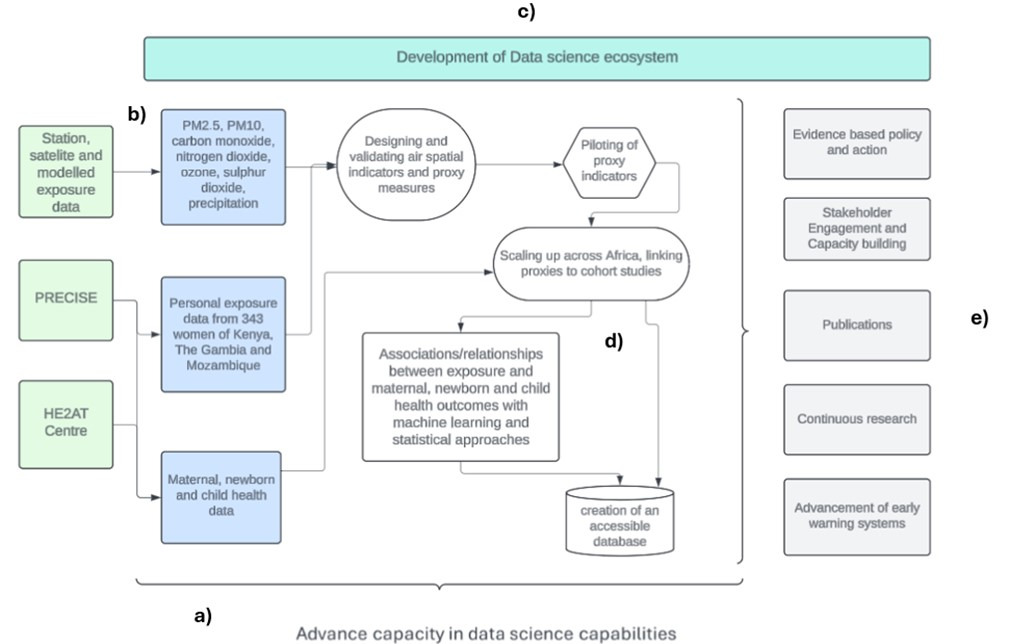
Research process workflow and output overview diagram for the CHEAQI-MNCH project

This research protocol describes the CHEAQI–MNCH project, which will develop and validate air pollution proxy indicators to examine the impacts of air quality on maternal, newborn and child health outcomes across sub-Saharan Africa.

This research initiative examines air pollution's effects on maternal, newborn, and child health outcomes across sub-Saharan Africa. The project will develop and validate air pollution proxy indicators using data from Kenya, The Gambia and Mozambique to examine the impacts of air quality on maternal, newborn and child health outcomes.

The methodology integrates geospatial analysis, machine learning algorithms, and existing cohort and clinical trial datasets. Key objectives include closing evidence gaps in regions with insufficient air quality monitoring infrastructure, establishing sustainable data science infrastructure, enhancing analytical capabilities among emerging researchers, and facilitating knowledge sharing with stakeholders and policymakers.

Authors: Munthali, L., Mushore, T. D., Nyoni, H. B., et al.
Journal: Journal of Global Health Economics and Policy, 6, Article e2026004
Funding: National Institutes of Health (Award U54TW012083, supplement 3U54TW012083-04S1, and U01ES036146)
Read the full protocol →
Funding Acknowledgement

Research was supported by the Fogarty International Center, National Institute of Environmental Health Sciences (NIEHS), and OD/Office of Strategic Coordination (OSC) of the National Institutes of Health under Award Number U54TW012083. Additional support was provided by the HarmonAIze supplement (3U54TW012083-04S1) and the CHEAQI-MNCH project (U01ES036146). The content is solely the responsibility of the authors and does not necessarily represent the official views of the National Institutes of Health.